Govt plans raising RMG's incentive to 5% to revive struggling spinners
Textile mill owners and garment exporters said increasing the incentive would significantly narrow, or even eliminate, the price gap between imported and locally produced yarn.

The government is set to step in to support the country's struggling spinning industry by raising the cash incentive for apparel exports made with locally produced yarn from the existing 1.5% to 5%. The move would cost the exchequer an estimated Tk3,800 crore.
Finance Minister Amir Khosru Mahmud Chowdhury assured textile industry leaders of the increase during a meeting yesterday, Showkat Aziz Russell, president of the Bangladesh Textile Mills Association (BTMA), told The Business Standard. Two other BTMA leaders who attended the meeting confirmed the development.
However, the enhanced incentive will exclusively benefit garment exporters using locally produced yarn. Spinning mills supplying the domestic market, which provide raw materials worth approximately $8 billion annually, will not receive this financial support.
 Keep updated, follow The Business Standard's Google news channel

Narrowing the price gap
Textile mill owners and garment exporters said increasing the incentive would significantly narrow, or even eliminate, the price gap between imported and locally produced yarn.
This will encourage apparel exporters to source more yarn from domestic textile mills, they said. Nearly 95% of Bangladesh's imported yarn currently comes from India.
Russell stated that the government is expected to issue the official order next week. The incentive will be paid to garment exporters based on the value of their exports.
"The higher incentive will narrow the price gap between locally produced and imported yarn to less than 10 US cents per kilogramme, or even eliminate it altogether," Russell said. "This will encourage garment exporters to source yarn from local textile mills instead of importing it. In other words, we will be able to remain competitive."
He added that the association had been pressing for this measure since the tenure of the interim government. "Had they acted then, more than 200 textile mills might not have shut down over the past two years," Russell noted.
Speaking on condition of anonymity, another BTMA leader told TBS that the prime minister had already taken a policy decision to support the textile sector after being briefed on its challenges and had given the relevant authorities the green light last Sunday.
According to the official, once the finance ministry approves the proposal next week, Bangladesh Bank is expected to issue the necessary circular.
When asked about the proposal, the Finance Minister declined to comment directly but stated: "We have already taken several initiatives to protect the industry. We will take more."
Textile sector under strain
According to BTMA data, Bangladesh imported yarn worth around Tk26,000 crore in FY25 despite having sufficient domestic capacity.
Garment exporters previously received a 4% cash incentive for using local yarn, but the government cut it to 1.5% in 2024 as part of preparations for LDC graduation. The incentive is also subject to a 10% tax, while lengthy processing costs further reduce its value.
Meanwhile, the Indian government has continued to support its textile industry, allowing Indian producers to export yarn to Bangladesh at lower prices, BTMA said. It said these measures had at one stage given imported Indian yarn a price advantage of about 30 cents.
According to BTMA, Bangladesh has more than 1,800 textile mills, including 527 spinning mills, with a total investment of about $23 billion. The association said the industry can meet the country's entire cotton yarn demand and around 60% of non-cotton yarn demand.
BGMEA President Mahmud Hasan Khan Babu said imports still account for around 40% of cotton yarn and fabric demand and nearly 90% of non-cotton yarn demand.
Price advantage to be 12-15 cents
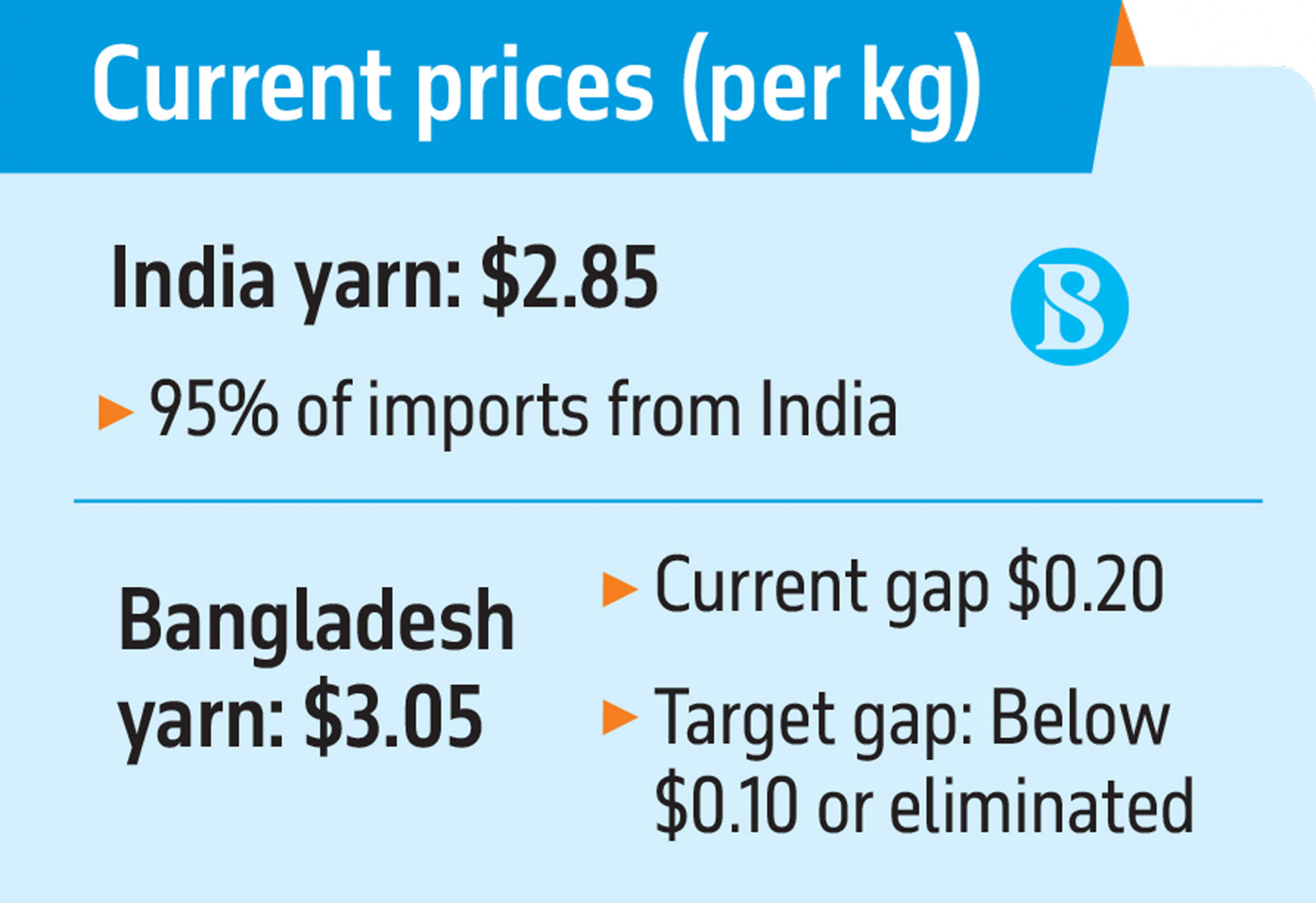
Textile mill owners said 30-count yarn currently sells for about $2.85 per kg in India, compared with around $3.05 for locally produced yarn in Bangladesh.
Garment manufacturers, however, said they would still prefer local yarn even if it costs up to 20 cents more, as domestic sourcing reduces banking, warehousing and work-in-process costs. If the proposed 5% cash incentive is introduced, exporters estimate the effective price gap would narrow to just 12–15 cents per kg after accounting for these savings.
"Our rule of thumb is to buy locally even if domestic yarn costs 20–30 cents more," BGMEA President Mahmud Hasan Khan Babu told The Business Standard. "The proposed incentive will narrow the gap to below 20 cents, encouraging greater sourcing from local mills."
"Bangladesh's textile mills are dying," he said. "The garment sector may not feel the impact immediately, but the consequences will become evident in two to three years."
Fakir Group, one of the country's largest apparel exporters, currently imports about 70% of its yarn requirements. Managing Director Fakir Kamruzzaman Nahid said the company would increase local purchases if the incentive improves price competitiveness.
Faisal Samad, managing director of Surman Garments, said importing yarn involves warehousing, banking costs and administrative hassles. "If the proposed incentive is implemented, purchases from local suppliers will certainly increase," he said.
Fazlul Hoque, managing director of Israq Spinning Mills, said no importer would choose foreign yarn if the price difference falls to around 20 cents per kg.
Israq Spinning Mills in Sreepur, Gazipur, can produce 5,000 tonnes of yarn a month, but around 30% of its capacity remains unused.
"If demand increases, we can fully utilise our capacity," Fazlul said. "We hope the government raises the cash incentive to boost sales and help save the sector."
Gas crisis needs to be resolved
Industry leaders said spinning mills are operating well below capacity because of weak demand and gas shortages, leaving about 30% of the country's yarn production capacity idle.
They said the proposed cash incentive would provide some relief, but uninterrupted gas supply is essential for the sector's long-term survival.
Khorshed Alam, managing director of Little Star Spinning Mills, told The Business Standard his factory is operating at just 60% capacity because of gas shortages.
"Our approved gas pressure is 10 PSI, but during peak hours we receive only 1–1.5 PSI, and sometimes no gas at all. It is becoming difficult to run the factory," he said.
He said the available gas is enough to operate only 20% of the mill's capacity. By supplementing it with electricity from the Rural Electrification Board, solar power and battery backup, the company has raised utilisation to about 70%.
Zaman Khan Jitu, managing director of export-oriented spinner NZ Group, said gas supply had briefly improved but has since fallen to its lowest level.
"Although our approved pressure is 15 PSI, we are getting only about 1 PSI, which is nowhere near enough to sustain production," he said.
He added that solar power meets only around 10% of the factory's energy needs. "The proposed incentive will deliver little benefit unless the gas supply improves."