Is Bangladesh's $23b textile sector edging towards collapse?
After years of energy shortages, soaring gas prices, high interest rates, generous allowable wastage rates, and a sharp cut in cash incentives, many textile mills are shutting down or operating below capacity

Bangladesh's textile industry, a $23 billion pillar of the country's export economy, is on the verge of collapse under a succession of shocks that millers say could push the sector into the hands of Indian and Chinese rivals.
After years of energy shortages, soaring gas prices, high interest rates, generous allowable wastage rates, and a sharp cut in cash incentives, many textile mills are shutting down or operating below capacity.
Industry leaders say this month's proposed national budget has delivered another big blow by removing the value-addition requirement on raw material imports against bank guarantees.
"Many textile mills will be closed now," said frustrated Mohd Khorshed Alam, a director at the Bangladesh Textile Mills Association (BTMA), referring to a government order this month that scrapped a rule requiring at least 30% local value-addition for goods made from imported yarn.
 Keep updated, follow The Business Standard's Google news channel
The rule, introduced in September 2025, had applied to exporters across the garment, leather, food processing, steel, plastics, and light engineering sectors.
Its removal is the latest in a string of setbacks for an energy-intensive industry that employs millions and underpins the country's position as the world's second-largest apparel exporter.
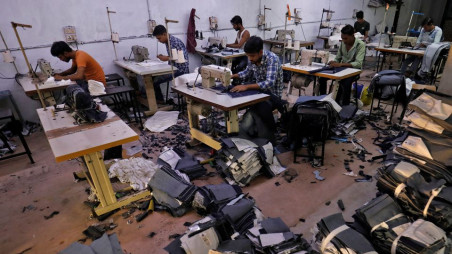
BTMA President Showkat Aziz Russell said scrapping the local value-addition rule could worsen misuse of the bonded warehouse system, making it harder for domestic mills to retain production capacity.
"This decision will push us towards ruin. It is the final nail in our coffin," Russell said.
According to him, a textile mill needs to operate at around 95% capacity to remain profitable and sustainable. But ongoing gas and electricity shortages have reduced utilisation rates to just 30%, putting many mills under severe financial strain.
Industry leaders warn that the backward linkage industries developed over decades to support Bangladesh's RMG sector are gradually losing ground to imported yarn from India and fabrics from China.
Consequently, the sector's local value addition has been eroding. It dropped to 61% in the January-March quarter, from over 64% in the preceding quarter and nearly 68% in the October-December quarter of FY23.
"If garment makers buy our fabrics, value addition would be over 70%," said Shahid Alam, a director of BTMA.
BTMA leaders also alleged discriminatory tax treatment, noting that readymade garment manufacturers pay a 12% corporate tax rate while textile mills are subject to a 27.5% rate.
Energy crisis, then gas price shocks
The sector's troubles began roughly five years ago with acute energy shortages that forced mills to shut for hours or days at a time, millers said.
Gas prices for industry then rose from Tk16 per unit to Tk30 in January 2023. The interim government subsequently raised gas tariffs further, to Tk40 per unit, for new factories and existing ones seeking to expand.
Mill owners say they often cannot get gas even at that price, forcing them to switch to costlier diesel or furnace oil.
Around 150 textile factories have closed in the past five years due to the gas crisis alone, said Saleudh Zaman Khan, managing director of NZ Tex Group and a former BTMA vice president.
BTMA President Russell, at a post-budget press conference this week, said 234 textile factories have been closed since 2019, including five of his own.
"The situation is getting aggravated every day. We are going to a position from where we will never be able to come back," Khan said.
Mosleh Uddin Ahmed, managing director of Shahjalal Islami Bank, said if the government wants to save the textile sector, it must first ensure an uninterrupted energy supply.

Interest rates and wastage rate for imported yarn
Interest rates jumped to 14-15% from mid-2024, pushing mills with term loans into financial distress, according to industry insiders and bankers.
Many millers defaulted on bank loans, cutting off access to working capital needed to keep operations running.
"Factories with term loans are suffering the most due to interest rates of 12-14%. Many mills are also facing a shortage of working capital," Ahmed said.
Explaining the banks' reluctance to provide working capital, he said many mill owners had failed to settle payments against their letters of credit (LCs), prompting banks to tighten lending to those borrowers.
A separate policy shift in 2022 raised the allowable wastage rate used to calculate duty-free yarn imports for garment production to 32% from 16%. In effect, garment makers can import nearly a third more yarn than they need without paying duty, under what is known as the bonded warehouse facility. Spinners said the wastage rate should be a maximum of 12-14%.
Textile millers say that provision has allowed importers to bring in yarn, much of it from India, and sell the surplus in the domestic market, undercutting local spinners.
Shahid Alam said the allowable wastage rate should be reduced as modern and efficient machinery has become widely available in the industry. "The wastage rate should be between 5% and 12%, not 32%."
He alleged that some unscrupulous businesses exploit the excessive wastage allowance by diverting surplus fabrics into the local market, earning as much as Tk20 lakh from a single truckload of fabric.
Khorshed Alam said textile mills sold $12 billion worth of goods domestically in 2017, when Bangladesh's population was 16 crore. Last year, despite a larger population, domestic sales had fallen to $8 billion. But it should be at least $13 billion, he said.
"Our local market sales are down by $5 billion now because of duty-free imports on yarn and fabrics being sold in the local market," Alam said.
'India dumping yarn'
Khan said Indian and Bangladeshi yarn are priced similarly at around $3 per kg, but government subsidies in India, including power subsidies and a 2% VAT rebate worth roughly Rs15-20, allow Indian mills to sell yarn to Bangladesh at about $2.90 per kg.
"India has been dumping its yarn for the last four to five years. As a result, many local spinners either could not sell their yarn or did so at a loss," Khan said.
He noted that Bangladesh has become the largest export market for Indian cotton yarn, with the neighbouring country selling over 40% of its yarn production, worth around $2 billion, to Bangladesh.
From exporter to importer
Bangladesh once exported fabrics to Turkey, but now imports more than $10 billion worth of fabrics annually, said AK Azad, a consultant to the textile sector.
He noted that leading business groups, including Beximco, Monno and Sinha, had invested in state-of-the-art fabric manufacturing facilities over the years, many of which have since shut down.
"When Turkey saw fabric imports from Bangladesh rising, it increased import duties to protect its domestic industry. In contrast, Bangladesh has allowed duty-free imports of yarn and fabrics for decades," Azad said.
Why foreign investment not flowing into textile sector
Khorshed Alam, who is also the president of the Bangladesh-China Chamber of Commerce and Industry, said many Chinese investors had shown interest in investing in Bangladesh's textile sector, given the country's large volume of fabric imports from China.
"After conducting market assessments, many prospective Chinese investors stepped back. They told us that the bonded warehouse facility is being widely misused in Bangladesh," he said.
Khorshed added that Chinese investors are also aware of the large volume of fabrics and garments entering Bangladesh illegally through various border points, reducing the market potential for legally imported fabrics.
"As a result, they fear their products would struggle to compete and find buyers in the local market," he said.
There are 1,780 mills under BTMA members. Of which, 519 spinning mills manufacture yarn and 938 are weaving mills that make fabrics. Also, there are 323 dyeing, printing and finishing mills. These backward and forward linkage industries provide employment to around 45 lakh people, out of which 60% is female, according to the BTMA.