Youth climate advocates trained on wetland restoration, campaign building

Young climate leaders in Dhaka learned advanced advocacy and communications skills at a day-long workshop aimed at strengthening community-led environmental action and promoting nature-based solutions.
The workshop, titled "The Art of Advocacy, Outreach, Media and Movement Building", was organised under the Climate Impacted Dwellers-led Agroecological Stewardship for Restoring Wetlands project and hosted by YouthNet Global in Dhaka.
The event convened 25 youth and community leaders—including urban growers and representatives from the Korail informal settlement—at a time of worsening wetland loss, urban flooding and mounting climate stress in Dhaka.
 Keep updated, follow The Business Standard's Google news channel
The initiative falls under the Reversing Environmental Degradation in Africa and Asia programme, funded by the United Kingdom Foreign, Commonwealth and Development Office and administered by an international environmental institute.
The programme supports locally led environmental restoration initiatives in Asia and Africa, including Bangladesh.
Organisers said the workshop aimed to provide grassroots actors with practical tools to shape public narratives, document local experiences and influence decision-making through strategic communication and collective action.
The day-long programme featured a documentary screening, interactive exercises, expert-led sessions, group discussions, artificial intelligence-based learning, content creation activities and structured action planning.
Participants explored how storytelling, social media, graphics, video production and community evidence can be leveraged to raise awareness, counter misinformation and reinforce local environmental movements.
The opening session on movement building and strategic communication was led by Executive Coordinator of YouthNet Global Sohanur Rahman. He said climate movements emerge from lived experiences and gain momentum when linked across communities and platforms.
"Local experiences must be translated into strong public narratives if we want real change in climate action," he said, underscoring the importance of youth-led advocacy in connecting grassroots realities with national and global policy spaces.
A second session on environmental and climate communication was facilitated by S M Shahin Alom, focusing on message framing, audience engagement and accessible storytelling techniques for climate advocacy.
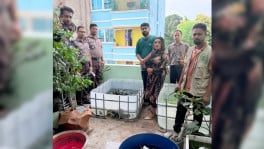
Urban farmers' leader from Korail Shahiduzaman Shyamal shared field experiences from the settlement and described changes since the start of Re-WET activities.
He said agroecological practices were contributing to a healthier local environment and highlighted increased biodiversity—including frogs, bees, snakes, birds, chickens and ducks—which he said was helping restore ecological balance.
Participants also learned about floating gardens and pesticide-free cultivation practices that support safe and fresh food production.
Shyamal said wetland restoration is not just an environmental intervention, but is closely linked to food security, livelihoods and community resilience in informal settlements.
The workshop also examined the role of emerging technologies in climate communication. Tech consultant Rehanuz Zaman led a session on artificial intelligence in advocacy and outreach, highlighting how digital tools can strengthen storytelling, enhance outreach efficiency and support youth-led climate campaigns.
Participants discussed how artificial intelligence-supported approaches can help grassroots organisations expand communication reach and respond more effectively to misinformation and information gaps.
In a creative campaigning session, Founder of Film by Asif Ahmad Udoy guided participants through visual storytelling and content production techniques.
"Good content connects with people's lived realities and turns awareness into action," he said.
Participants also developed group campaign ideas on wetland protection, urban flooding and environmental awareness in vulnerable communities.
In the final session, facilitated by Mohaiminul Islam Zipat, participants drafted year-long communication and outreach action plans, translating workshop discussions into community-based strategies for climate advocacy.
Key outcomes included enhanced understanding of advocacy and communication tools, group action plans for Re-WET promotion, and renewed commitment to community-centred wetland protection and youth-led climate action.
Participants finalised group plans with defined roles, timelines and responsibilities. They also developed ideas for social media content—including reels, photo stories, graphics and short documentary concepts—to support Re-WET outreach.
A content calendar for Re-WET promotion and Korail community storytelling was introduced, along with follow-up mentoring on artificial intelligence-supported campaign design, ethical communication, and content production.
Participants were encouraged to engage policymakers, media and stakeholders through community-centred messaging. Documentation—including photos, videos, attendance records and reflection notes—was emphasised to ensure continuity and accountability.
The programme concluded with a certificate distribution ceremony attended by representatives from the project and YouthNet Global.
The workshop was conducted under Re-WET, a collaborative initiative focused on restoring Dhaka's urban wetlands in response to increasing risks of flooding, heat stress and environmental degradation.
The initiative is implemented in partnership with several academic, research and civil society organisations.
At the centre of the initiative is the Gulshan-Banani Lake area near the Korail settlement, where the "Nogor Abad" cooperative is demonstrating a community-led model of ecological restoration.
More than 100 urban farmers are acting as environmental stewards, cultivating over 30 crop varieties on previously degraded land and transforming the area into a productive green commons.
Organisers said the model shows how community ownership, supported by technical and institutional assistance, can help restore degraded urban ecosystems and build resilient livelihoods.
They said the rapid loss of urban wetlands in Dhaka is closely linked to worsening flooding, rising temperatures and declining liveability in low-income settlements.
As Bangladesh faces intensifying climate pressures, organisers said the skills gained through the workshop would help participants strengthen advocacy, shape policy conversations, and scale grassroots climate solutions beyond their communities.