Rethinking Bangladesh’s economic ties with the US as it turns 250
Bangladesh earns billions of dollars from American consumers and from Bangladeshis living in the US, yet attracts comparatively little American capital. That matters because investment is the only one of the three channels that Bangladesh can influence most directly

The United States celebrated the 250th anniversary of its Declaration of Independence on 4 July 2026 with fireworks, flyovers and nationwide festivities.
Watching the celebrations was a reminder not only of America's history and power, but also of its economic dominance. That raised a simple question: how much does Bangladesh earn from the world's largest economy?
The answer, in FY25, is the equivalent of just over 3% of Bangladesh's $456 billion economy.
 Keep updated, follow The Business Standard's Google news channel

That share comes from two major sources of income: remittances from Bangladeshis living and working in the US, and export earnings from factories selling to American buyers.
Both expanded strongly in FY25, even as a third channel—US investment in Bangladesh—has weakened in recent years.
Begin with remittances, the lifeblood of Bangladesh's foreign exchange reserves.
Money sent home by Bangladeshis in the US rose 59.8% in FY25, reaching $4.73 billion, according to Bangladesh Bank data.
That growth rate outpaced every other major remittance source, pushing the US past Saudi Arabia to become the single largest contributor to Bangladesh's total remittance inflows of $30.3 billion, accounting for around 15.6% of the total, the Bangladesh Bank data showed.
US remittances alone now equal about 1.04% of Bangladesh's GDP.
That is worth pausing on. Bangladesh's diaspora in the US is far smaller than its migrant workforce in the Gulf. Yet it now sends home more money than the much larger Bangladeshi workforce in Saudi Arabia.
Either wages in the US are simply higher, or Bangladeshis there are sending home a larger share of what they earn—and either explanation says something about how much economic weight rests on a relatively small group of people.
Exports make the same point on a larger scale.
According to data released by the Export Promotion Bureau, the US remained Bangladesh's largest export market in FY25, importing $8.69 billion worth of goods, up 14.4% from the previous year.
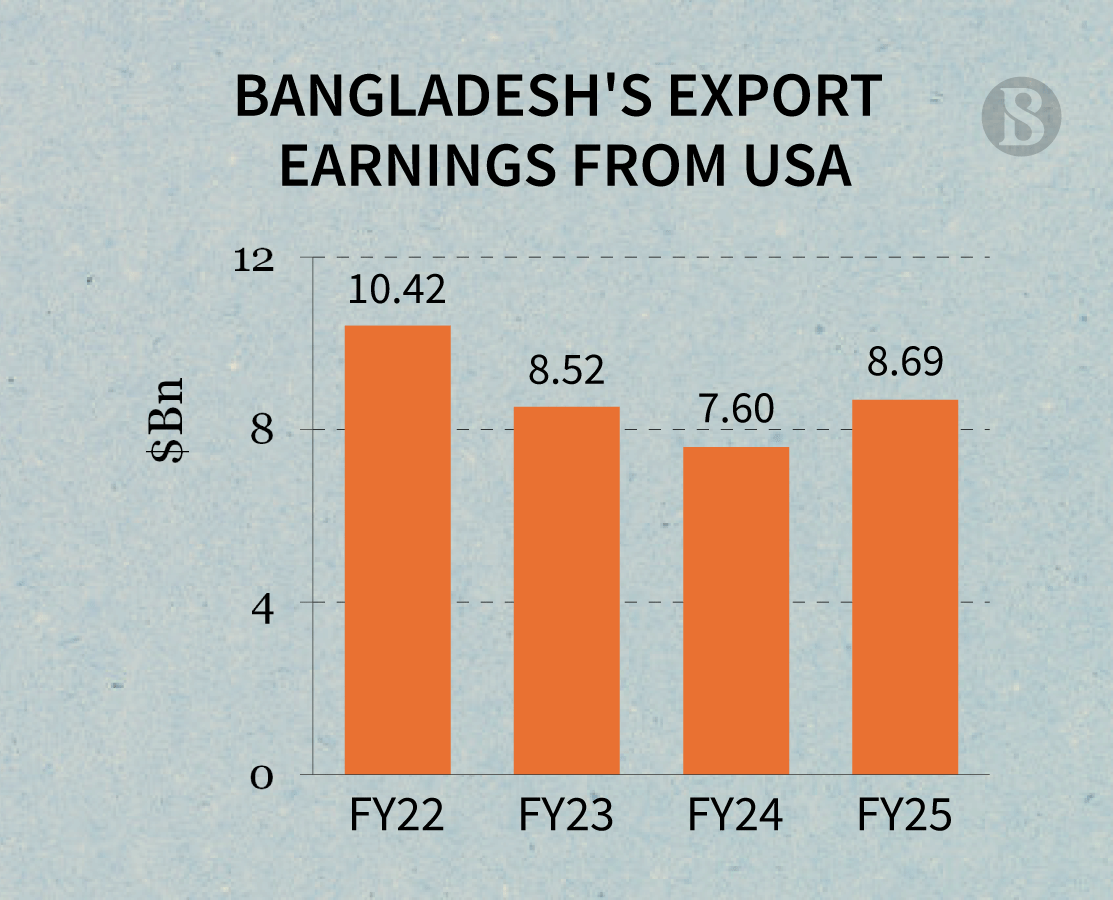
In FY25, export earnings from American buyers accounted for 18% of Bangladesh's total merchandise exports and nearly 2% of the country's GDP.
The export basket for the US remains heavily concentrated in the apparel sector. Woven garments generated $4.95 billion in export earnings, while knitwear contributed another $2.60 billion.
More than one-quarter of all woven garments exported by Bangladesh are destined for the US market.
This reflects a high degree of market concentration—one that has been masked by the success of Bangladesh's overall export performance.
Investment shrinking for three years running
Here is where the imbalance becomes apparent. While remittances and exports have grown, American investment has not followed, even though the US remains the seventh-largest foreign investor in Bangladesh.

US foreign direct investment (FDI) stock in Bangladesh fell to $1.08 billion at the end of 2025, down from $1.11 billion in 2024, $1.25 billion in 2023 and $1.28 billion in 2022, according to Bangladesh Bank data.
Bangladesh's diaspora in the US is far smaller than its migrant workforce in the Gulf. Yet it now sends home more money than the much larger Bangladeshi workforce in Saudi Arabia. Either wages in the US are simply higher, or Bangladeshis there are sending home a larger share of what they earn—and either explanation says something about how much economic weight rests on a relatively small group of people.
That marks a third consecutive year of decline, in stark contrast to other US-linked economic indicators, including remittances and trade, which have continued to strengthen.
This should worry Bangladeshi policymakers more than it appears to.
Remittances depend on individual workers and immigration policies in a country Bangladesh does not control.
Exports depend on tariff decisions made in Washington, as this year's negotiations demonstrated. Both channels are, in a real sense, exposed to decisions over which Dhaka has limited influence.
Investment is different. It is perhaps the clearest measure of American businesses' confidence in Bangladesh's institutions and governance—and by that measure, confidence is falling, not rising.
The usual explanations for weak FDI apply here: bureaucratic delays, inconsistent policy enforcement, and difficulties in moving capital into and out of the country.
A recent UNCTAD report, World Investment Report 2026, placed this in sharper context, noting that Bangladesh's FDI performance trails that of much smaller African economies such as Uganda, Ghana and the Democratic Republic of the Congo.
Bangladesh's economic relationship with the US is already substantial. The country earns billions of dollars from American consumers and from Bangladeshis living in the US, yet attracts comparatively little American capital.
That matters because investment is the only one of the three channels that Bangladesh can influence most directly.
It is encouraging that the government has stepped up efforts to improve Bangladesh's business climate through regulatory reforms, stronger investment facilitation, and measures to make doing business in the country easier.
Meanwhile, whether Bangladesh graduates from the LDC category this year or receives additional time to prepare, the underlying challenge remains the same.
Sustaining growth through exports and remittances will not be enough. Making Bangladesh a more predictable, transparent and competitive destination for investment may prove to be the country's most important economic reform.
Md Emon Ahmed is pursuing an MS in Business Analytics at the Zicklin School of Business, Bernard M Baruch College, part of the City University of New York.

Disclaimer: The views and opinions expressed in this article are those of the author and do not necessarily reflect the opinions and views of The Business Standard.