Between two skies: How a parliament built by an American architect hosted America's 250th birthday
As Dhaka marked 250 years of American independence beneath Louis Kahn’s Parliament, an American military band traded jazz standards for Ayub Bachchu — and the evening’s real story turned out to be the building itself, a monument to two countries written into each other’s skylines

The afternoon began the way most Dhaka afternoons in the monsoon season do — with a heat that sat on the skin like a hand. By late afternoon, the sky over the South Plaza of Jatiya Sangsad Bhaban had split itself in two.
On one side, the sun burned bright and unbothered. On the other, monsoon clouds gathered in dark, low banks, heavy with the threat of rain that, as it turned out, never came.
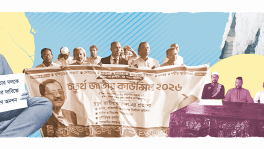
It was in this uncertain light that the Bangladesh Caucus and the US Embassy in Dhaka gathered members of parliament, diplomats, and distinguished guests to mark the 250th anniversary of American independence — and, in the same breath, to launch the Bangladesh Caucus committee itself.
By evening, the clouds had lost their nerve and drifted off. What replaced them was a wash of gold across the face of the Parliament building, birds crossing the open sky in loose formation, the kind of light that makes even a familiar building look freshly discovered.
It was, in the end, an evening where the architecture did more talking than the music did.
A building as common ground
That the celebration of American independence unfolded in front of the National Parliament was not incidental. The building was designed by Louis Kahn, the American architect whose Sangsad Bhaban is widely regarded as one of the defining works of twentieth-century architecture — and one that predates Bangladesh's own independence. Kahn never lived to see the country he had, in concrete and light, helped imagine.
US Ambassador Brent Christensen leaned into that history in his remarks, delivered partly in Bangla. He thanked the newly formed Bangladesh Caucus committee and invoked Kahn directly, calling the Parliament building itself a shared inheritance — a physical symbol of the friendship between the two countries.
"The music you'll hear today reflects that friendship," he said. "American songs and Bangladeshi songs, sung by the same people."
On the significance of the anniversary itself, Christensen framed it as more than commemoration. "We celebrate 250 years of American freedom," he said. "It doesn't only mean 250 years of the past; it also means 250 years of the future."

Two architects, two countries
If Christensen's remarks located the friendship in music, Barrister Kaisar Kamal located it in steel and concrete. In his address, Kamal drew out a parallel that ran through much of the evening's messaging: Louis Kahn had left an American signature on Bangladesh through the Parliament building, while Fazlur Rahman Khan — the Bangladeshi structural engineer whose innovations in skyscraper design reshaped American cities — had left a Bangladeshi signature on the United States.
Kahn's Parliament in Dhaka; Khan's tube-frame skyscrapers rising over Chicago and beyond. Kamal offered the pairing as evidence of a connection between the two nations that predates and outlasts any single diplomatic occasion — one written into skylines rather than speeches.
Chief Whip Nurul Islam spoke to the occasion from the other direction, tracing Bangladesh's own democratic journey and framing the evening as a moment to reflect on the country's continuing struggle for democratic governance — a note that sat comfortably alongside the American theme of the night without being subordinate to it.
Songs sung by the same people
The music itself came from an American military band, which opened with the national anthems of both Bangladesh and the United States before easing into a set built largely around jazz. The band worked through a run of American jazz standards — brass and rhythm section trading the kind of loose, improvisational lines that felt distinctly out of place against the stiff formality of a parliamentary plaza, and all the more charming for it.
They moved fluidly between the two repertoires, folding in Bangladeshi songs alongside the American numbers, including a rendition of Ayub Bachchu's "Sei Tumi" that drew visible warmth from the Bangladeshi guests in attendance. The pairing of jazz's improvisational looseness with the rigid, geometric lines of Kahn's building made for an odd but fitting contrast — one idiom of freedom set against another.
But for much of the evening, the songs felt almost secondary to the setting they were performed in. Guests who had arrived squinting against the afternoon sun stayed on for a sky that had, by the time the anthems played, gone soft and gold. The Parliament building — Kahn's building — stood behind the performers the entire time, catching the last of the light.
A diplomatic backdrop
Among those in attendance were Hummam Kader Chowdhury, Barrister Nowshad Jamil, Jamaat-e-Islami Amir Shafiqur Rahman, Mir Ahmed Bin Kashem, Nipun Roy Chowdhury, and Marzia Momtaz, alongside other members of parliament and diplomats.
What the evening ultimately staged was a kind of architecture-as-diplomacy — a reminder that some of the oldest ties between Bangladesh and the United States are not found in treaties or trade figures, but in a parliament building designed by an American who never lived to see it finished, and in the skyline of an American city shaped by an engineer who was born in Dhaka. Between them, on a July evening when the sky couldn't decide whether to rain, that history had a stage of its own.
 Keep updated, follow The Business Standard's Google news channel