Where are all the HSC examinees?
Nearly 550,000 students are absent from this year’s HSC examinations, exposing a deepening crisis in the country’s education system

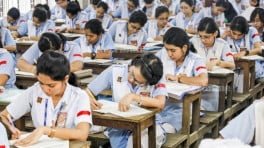
On Thursday, 2 July 2026, a familiar scene unfolded across Bangladesh: students in crisp uniforms, clutching admit cards and geometry boxes, filed into 2,697 examination centres to begin their Higher Secondary Certificate (HSC) and equivalent examinations. Yet, there was something amiss; one out of three of them were simply not there. This as the Gen-Z examinees would themselves say are "not rookie numbers".
Or as the more seasoned economist Hossain Zillur Rahman put it in a recent interview, "There can hardly be a greater psychological jolt than the fact that 36% of students are not sitting for an examination as important as HSC."
Out of approximately 1.5 million students who passed the SSC and equivalent examinations in the 2024-25 academic year and registered for Class XI, only about 950,000 students have registered for this year's HSC and equivalent examinations.
 Keep updated, follow The Business Standard's Google news channel
This means that roughly 550,000 regular students are not sitting for the exams. For every student sitting down to write their future, another story of a candidate who has effectively vanished from the higher secondary education ladder within just two years of clearing the SSC remains untold.
The workforce and the lure of migration
For male students, especially from rural Bangladesh, the biggest driver is often economic survival. "Poverty, and many students joining the workforce after passing SSC are significant reasons for this trend."
Professor Md Azam Khan, director of the Institute of Education and Research at Jagannath University, said in a recent interview with Financial Express, "Unemployment has become so severe that young people are losing confidence."
When "even many university graduates cannot find jobs," a student who barely passed the SSC often "sees little reason to continue studying".
In districts like Brahmanbaria and Bogura, the trend toward "migration for work" is particularly acute.
Obaidul Haque, Principal of Brahmanbaria Government College, told TBS, "Many students tend to drop out of their studies and go abroad for work. This year, too, many examinees have left the country to seek employment overseas."
According to him, it is primarily students from comparatively less affluent families who are abandoning their education to migrate abroad.
At Kazi Shafiqul Islam University College, out of six absentees on the first day, two boys had joined the police as constables, while two others migrated abroad for the sake of livelihood.
In Bogura, Principal A H M Shafiqut Tarik of Government Kamaruddin Islamia College noted that "at least 5% students... go into the working life," often joining the army, police, or driving CNGs and vans.
Social crisis: Child marriage and addiction
When authorities began to dig for answers, child marriage emerged as a primary cause. An analysis by the Dhaka Education Board found that among absentee students nearly 41% had married, indicating that child marriage was the primary cause of absence.
In Brahmanbaria, college authorities confirmed that due to marriage, the education of female students has been stopped. At Bhaya Laxmikul Budirhat College in Rajshahi, Principal Tawabur Rahman noted, "Many girl students get married. Primarily, poverty and marriage are the reasons these students drop out."
Beyond marriage, modern lifestyle shifts are also taking a toll.
Principal Rezaul Islam Molla of Sakoa Degree College believes "addiction to social media and social indifference to studies" are leading causes for students abandoning their education. Families often show a "lack of interest in education", allowing students to "easily drift away from studies".
Economic inflation and environmental drivers
The economic and environmental drivers cannot be ignored. Inflation and the increased cost of living in recent years mean many families can no longer bear the cost of their children's education.
This year, HSC form fill-up fees rose with the maximum fee fixed at Tk2,995 for the science group, representing a flat increase of Tk210 compared to last year. When added to the 24 months of tuition fees that colleges are authorised to collect, the financial burden becomes insurmountable for insolvent families.
Regarding the reasons why so many students drop out every year, Anisur Rahman, the former principal of Khulna Government Sundarban Adarsha College, "Families in the coastal, char [river island], and flood-prone areas of our country frequently relocate due to cyclones, river erosion, waterlogging, and salinity. This disrupts the students' education and leads to dropouts.
"Moreover, in many cases, a lack of interest in education within the family makes it easy for students to drift away from their studies," he added.
The return of academic rigour
A significant, yet less discussed, driver of this decline involves a fundamental shift in how exams are administered and graded.
According to a recently retired college professor from Khulna, "If you look at the trend, there was a drop last year as well. In the past there was pressure on us not to fail students, this allowed a lot of students to pass without studying properly. I teach English, if the examinee has not given the correct answer, how am I supposed to give them the passing grade? Yet, we were pressured to do so.
"Now that the political scene has changed, the education board has instructed the educators to properly evaluate the exam papers. Which is why the number of unsuccessful students rose sharply last year," she added.
She believes many students who were expecting things to be the same forever and did not study have dropped out from the HSC exam.
"Also outside of the major cities the practice of 'opening up the exam hall' has taken deep roots. This means the invigilators taking a blind eye to students cheating and copying from each other. From last year we are getting fewer reports of authorities allowing such deeply unethical practices. Most likely, this has also contributed to the decrease in students," explained the college professor.
This new rigour is being felt at the preparatory or test examination stage. "The requirement to sit for preparatory exams" remains a significant filter for candidates. In Sariakandi Degree College, at least 200 students failed the test exam, preventing them from even filling out the final examination forms.
Principal Sahanoara Sultana of Gazipur's Bhawal Badre Alam Government College explained that the "main reason for not being able to fill out the form... is failing in multiple subjects in the test exam". Institutions, eager to protect their "reputation for 100% pass rates," often refuse to allow underprepared students to sit for the final boards.
A crisis of quality and confidence
Perhaps the most insidious reason for the decline is a "loss of faith in academic value". Despite tons of students getting GPA-5, a vast majority of them are failing university admission tests. At Dhaka University, only 10.23%, or 27,488 got the pass mark in recent tests.
Experts believe students are getting grades that do not reflect their level of competence, a phenomenon known as "grade inflation".
Hossain Zillur Rahman told Prothom Alo that the absence "reflects the deplorable state of our overall education system". He noted that since the July Uprising, "teachers have been humiliated and harassed. Mobs have emerged on educational campuses," which has "diminished much of what that movement stood for" and "contributed to the growing disillusionment with education".
"Families in the coastal, char [river island], and flood-prone areas of our country frequently relocate due to cyclones, river erosion, waterlogging, and salinity. This disrupts the students' education and leads to dropouts. Moreover, in many cases, a lack of interest in education within the family makes it easy for students to drift away from their studies." Anisur Rahman, former principal, Khulna Government Sundarban Adarsha College
The government's response: Identifying the 'weaknesses'
Education Minister ANM Ehsanul Hoque Milon has acknowledged the severity of the crisis. "Why are students dropping out? Who will answer that question? Surely, we have to," he stated during a recent press conference.
He described the current figures as "worrying" and promised that "these weaknesses are being identified, and necessary actions... will be taken in the future".
The government plans to launch targeted initiatives and research-based investigation to gather field-level data starting in August. In the meantime, the Ministry is focusing on security, deploying "police officers... with body-worn cameras" to centres to prevent "unfair means" and "outsiders".
A wake-up call
The empty desks left behind by hundreds of thousands of missing students may be the most urgent question confronting Bangladesh's education system today.
We can go on setting ambitious targets, but they will remain nothing more than words on paper unless we learn to engage this generation, and to listen to them with genuine seriousness and empathy. If they turn away from the state and from education altogether, we will have no future to speak of.
The era of rhetoric must end; what the nation needs now is a serious, soul searching as to why its young people are slipping off the ladder of progress.