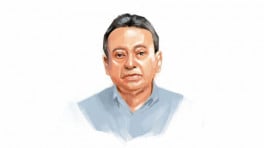
Govts should not become the arbiters of truth: Joan Barata
International media law expert Dr Joan Barata spoke to The Business Standard on the sidelines of BJDC 2026 in Dhaka about international human rights standards, cross-border disinformation, declining trust in traditional media, and the risks of governments regulating information in the name of combating misinformation

Dr Joan Barata is a Visiting Professor at the Católica University School of Law in Porto, Portugal, while holding prominent research positions as a Senior Legal Fellow at Vanderbilt University's Future Free Speech project and a Fellow at the Stanford Cyber Policy Center's Program on Platform Regulation. His work in policy and advocacy was further expanded in January 2026 when he joined the academic constituency of the Global Network Initiative (GNI), where he focuses on advancing rights-respecting media and platform governance.
Speaking to Shadique Mahbub Islam from The Business Standard at the Bangladesh Journalism Conference 2026, organised by the Media Resources Development Initiative (MRDI) in Dhaka, Joan Barata discussed the challenges posed by cross-border disinformation, declining trust in traditional media, and the dangers of governments regulating information flows in the name of combating misinformation.
TBS: In countries like Bangladesh, where democratic institutions are still developing, to what extent can international human rights standards realistically be followed?
 Keep updated, follow The Business Standard's Google news channel
The first important reason is that Bangladesh ratified and signed the International Covenant on Civil and Political Rights, which includes Article 19 guaranteeing freedom of speech and expression. So Bangladesh committed itself to respecting those standards.
The other thing is that these standards are, in a way, aspirational. They set the direction that needs to be taken in order to achieve certain objectives.
It is obvious that depending on the level of development, democratic quality and many other factors, these standards will be followed or adopted at different paces. In some cases, it may take longer.
But what is important about international standards is that they indicate the direction we need to take and the objectives we need to pursue. Anything that radically goes against those principles means going backwards, and that should not happen. They provide a general framework for states to articulate the necessary measures and determine the process needed to fully respect those standards.
TBS: Bangladesh experienced a major wave of disinformation after 5 August, much of it originating outside the country. How can cross-border misinformation campaigns be addressed?
That's the world we live in. We cannot simply put up artificial frontiers unless we want to become China, North Korea or Iran. We need to accept that we live in a globalised world and this is going to happen.
What this shows is the need to reinforce the structures and mechanisms at the national level to improve the quality of the information space.
You can still have information coming from other countries, but if you have a solid media system, access to information, reliable media and trusted institutions, the impact of those external messages becomes much lower. But that only means countries need to reinforce their institutions.
They need proper mechanisms to ensure, for example, that people contesting elections are not receiving undeclared money or funding from questionable foreign sources.
So this is not only about controlling the information space. It is also about having a solid institutional system that ensures everything takes place according to proper procedures and that there is no fraud in the use of money or influence.
TBS: Trust in traditional media appears to be declining globally, while many alternative platforms with questionable credibility are gaining audiences. How can conventional media regain public trust?
Traditional media need to earn that trust again.
In some cases, they are not ethical. In other cases, they are so heavily regulated that they do not have the freedom to report properly. Sometimes they lack independence when it comes to ownership structures. In other cases, they do not have clear professional ethics.
So it is understandable that the public may be tempted to follow alternative sources.
What is important is for media organisations to regain trust by showing they are truly independent.
At the same time, countries also need legal, regulatory and political frameworks where media can operate freely and professionally.
TBS: Governments across the world increasingly justify tighter regulation in the name of combating misinformation and disinformation. How dangerous can that become?
That would be terrible. Because then the government becomes the arbiter of truth.
We do not want governments deciding what is true and what is false. Governments should promote a diverse media environment. They should promote ethics and professionalism.
But governments should not decide what is good information and what is bad information.
TBS: Much of the discussion around misinformation focuses on digital platforms. But are traditional media issues sometimes overlooked in the process?
Absolutely. In Bangladesh, there are still many laws affecting traditional media and freedom of expression in general that probably need to be updated in order to be fully aligned with international human rights standards. We should not forget that.
When it comes to traditional media —including both digital and analogue media — there are still major issues involving access to information and the safety of journalists. There are provisions that are still lacking, and there are things that still need to be done and fulfilled. We should not neglect that reality.
The digital world is important, but not everything is digital.