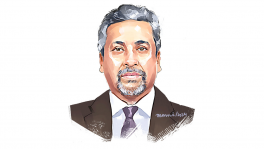
Who was Ali Larijani, the Iranian official killed in an Israeli strike
Unlike many of his peers, Larijani had a secular academic background, earning a degree in Mathematics and Computer Science and later completing a doctorate in Western philosophy, focusing on Immanuel Kant

Ali Larijani, born in 1958 in Najaf, Iraq, was a senior Iranian official and member of the influential Larijani family, sometimes described as the "Kennedys of Iran" by Time Magazine in 2009 because of their extensive roles across the judiciary, religious councils, and political institutions.
Unlike many of his peers, Larijani had a secular academic background, earning a degree in Mathematics and Computer Science and later completing a doctorate in Western philosophy, focusing on Immanuel Kant, says AL Jazeera.
Political career and influence
Larijani's career spanned decades and multiple sectors of the Iranian state. He served in the Islamic Revolutionary Guard Corps (IRGC), held the position of Minister of Culture, and led the state broadcaster IRIB. From 2008 to 2020, he was Speaker of Parliament for three consecutive terms, influencing both domestic and foreign policy.
 Keep updated, follow The Business Standard's Google news channel
He also played a key role in Iran's nuclear program. As chief nuclear negotiator, he helped secure parliamentary approval for the 2015 nuclear deal (JCPOA). For decades, Larijani was known for a pragmatic approach, often serving as the "calm face" of the establishment.
In an interview prior to the US-Israel attacks, he said, "Resorting to negotiation is a rational path" and described Iran's position on talks as "positive." He also called the 2024 disqualification of his presidential candidacy "non-transparent."
Shift in approach and final role
Following the deaths of Supreme Leader Ayatollah Ali Khamenei in February 2024 and IRGC commander Mohammad Pakpour, Larijani's tone shifted. In August 2025, he was reappointed as secretary of the Supreme National Security Council. After the outbreak of the US-Israel war on Iran, he abandoned his previous moderate tone.
Larijani issued statements directed at the US and Israel, saying:
"America and the Zionist regime [Israel] have set the heart of the Iranian nation ablaze."
"We will burn their hearts. We will make the Zionist criminals and the shameless Americans regret their actions."
"The brave soldiers and the great nation of Iran will deliver an unforgettable lesson to the hellish international oppressors."
He clarified his military intentions, noting, "We are not intending to attack regional countries but we are targeting any bases used by the United States." Regarding potential US ground forces, he said, "The valiant sons of Imam Khomeini and Imam Khamenei are waiting for you, ready to disgrace those corrupt American officials by killing and capturing thousands."
Larijani also publicly rejected international oversight in the nuclear arena, declaring that International Atomic Energy Agency (IAEA) reports were "no longer effective."
Larijani family: the "Kennedys of Iran"
The Larijani family, originating from Amol, Iran, has held significant influence in politics and religion. Patriarch Mirza Hashem Amoli was a respected religious scholar. Family members have occupied leadership roles in the judiciary, the Assembly of Experts, and other top institutions. Ali Larijani's brothers also held high-ranking positions.
The family's influence extends through elite marital and personal ties. At age 20, Larijani married Farideh Motahari, daughter of Morteza Motahhari, a close confidant of the Republic's founder, Ruhollah Khomeini.
Despite conservative roots, family members pursued secular and international education, including Larijani's own studies in mathematics and philosophy, and his daughter Fatemeh's medical specialization in the United States.
Philosophical background and political identity
Larijani's academic training shaped his approach to statecraft. His studies in philosophy contributed to a reputation for pragmatism, rationalist rhetoric, and a willingness to negotiate on nuclear issues. Even in high-level security roles, he maintained his intellectual pursuits, writing on Kant while steering security policy.
However, following the death of Khamenei, Larijani's pragmatic approach gave way to defiance. In the days after the escalation, he said, "We are not intending to attack regional countries but we are targeting any bases used by the United States." He also emphasized Islamic solidarity, stating, "If you do not respond to the cry of a Muslim, you are not a Muslim. What kind of Islam is this?"
Death and strategic implications
Larijani was killed in an overnight Israeli strike in March 2026 during the ongoing US-Israel war on Iran. Israeli Minister of Defence Israel Katz confirmed his death.
Tohid Asadi, an Al Jazeera reporter, described the loss to the Iranian establishment as "significant," noting, "He played an important role in strategic decision-making after the killing of Khamenei" and "finding an alternative to someone like Larijani is not going to be an easy task."
Asadi added, "He was one of the key figures in both controlling the war and maybe in reviving a hope of a possible de-escalation in this already highly delicate situation."
Larijani's death removes a key figure in Iran's wartime decision-making and a potential—though ultimately abandoned—bridge for de-escalation.