Ramisa rape-murder: Sohel, wife sentenced to death
The verdict was delivered only 20 days after the incident.
Highlights:
- Court fines Sohel Rana Tk5 lakh and his wife Tk2 lakh alongside the death sentence
- Prosecution says the verdict ensures justice for the victim's family
- Both accused brought from jail under heavy police escort for the verdict
- Defence sought life imprisonment for Sohel Rana and a lesser sentence for his wife
- Large public and media presence observed at the court during the verdict announcement
A Dhaka tribunal has pronounced the death penalty for the accused Sohel Rana and his wife Swapna Akter in the widely discussed case over the rape and murder of child Ramisa Akter in Pallabi, Dhaka.
Judge Masrur Salekin of the Dhaka Metropolitan Tribunal for the Prevention of Violence Against Children delivered the verdict in the presence of the accused today (7 June).
 Keep updated, follow The Business Standard's Google news channel
Additionally, Sohel was fined Tk5 lakh and Swapna Tk2 lakh.
The prosecution has expressed satisfaction after a Dhaka court sentenced prime accused Sohel Rana and his wife, Swapna Akter, to death in the rape and murder case of child Ramisa Akter in the capital's Pallabi area.
Reacting to the judgment, Special Public Prosecutor Azizur Rahman Dulu said, "Ramisa's family has received justice. We are satisfied."
Ramisa Akter's father, Abdul Hannan Molla, has expressed satisfaction after a Dhaka tribunal sentenced the main accused, Sohel Rana, and his wife Swapna Akter to death in the case over the rape and murder of his daughter in Pallabi.
In his reaction, Hannan said, "I am 100% satisfied with the verdict. I have received what my heart expected and desired through this judgment. I am fully hopeful that the verdict will be implemented quickly."

He further expressed gratitude to the police, journalists, and the people of Bangladesh who supported him and his family during their difficult times.
Hannan added that he wants to see the swift execution of the verdict in his daughter's murder case.
Meanwhile, the death sentence of the main accused, Sohel Rana, and his wife, Swapna Akhtar, has been welcomed by the state-appointed defense lawyer. In his reaction to the verdict, defense counsel Musa Kalimullah said that the accused Sohel Rana had given a confessional statement admitting his guilt and also confessed during his self-defense statement. With the court announcing the death sentences for Sohel and Swapna, he stated that justice had been served, the criminals had faced justice for their crime, and he was satisfied with the verdict.
Security measures have been significantly strengthened in and around the court premises. Additional police personnel have been deployed, while surveillance has been increased across the tribunal area.
The accused were produced before the court this morning ahead of the verdict.
Prime accused Sohel Rana and his wife, Swapna Khatun, were brought into the courtroom at around 10:45am under tight police security.
The tribunal is scheduled to deliver its verdict at 11am today by Judge Masrur Saleqin of the Dhaka Metropolitan Tribunal for the Prevention of Violence Against Children in the presence of the accused.
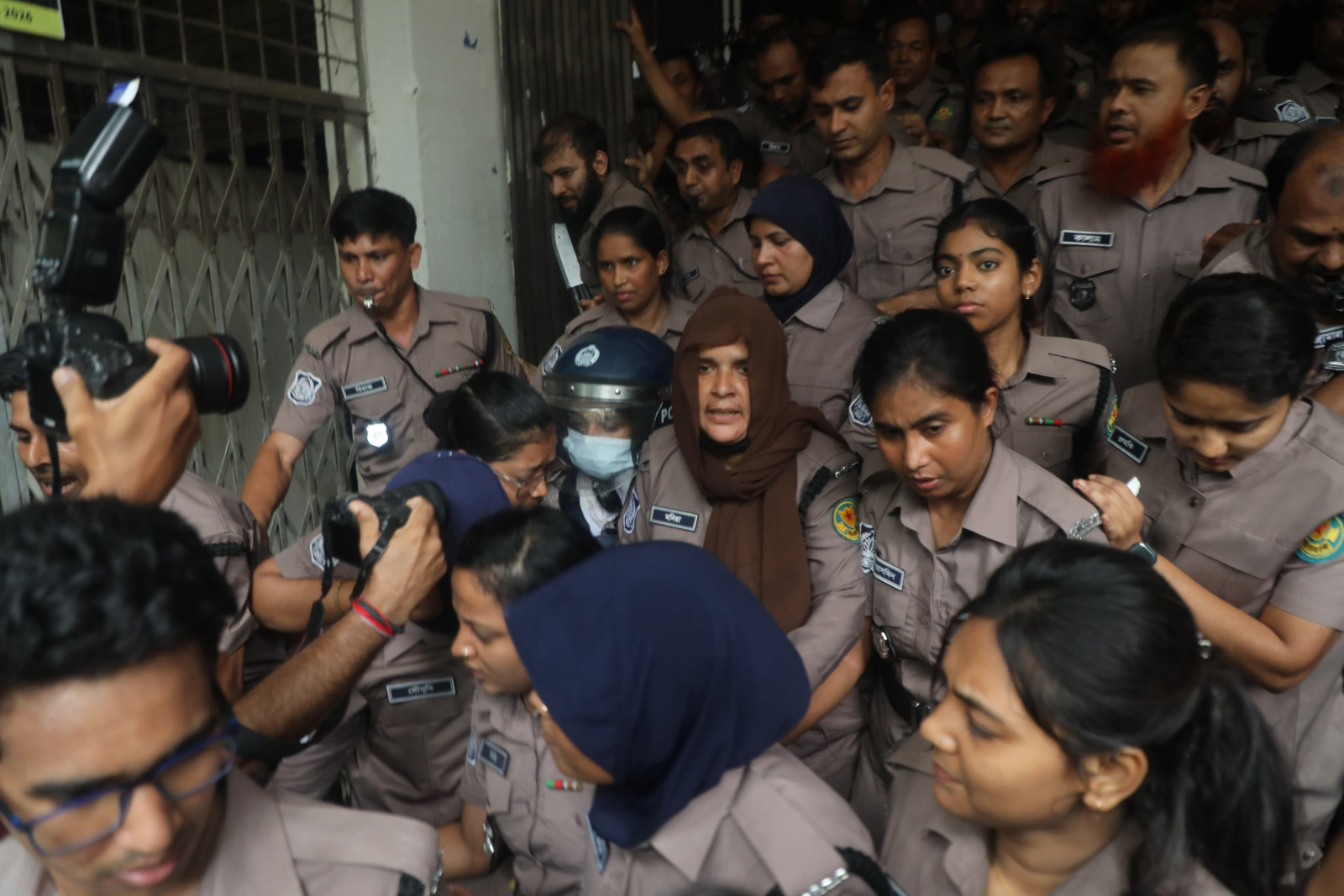
At around 8:25am today, accused Swapna Khatun was brought from Kashimpur Central Jail to the premises of the Dhaka Metropolitan Sessions Judge's Court. She was subsequently placed in the court's holding cell.
At approximately 8:45am, the main accused, Sohel Rana, was brought to court from Dhaka Central Jail in Keraniganj. He was also placed in the holding cell of the Dhaka Metropolitan Sessions Judge's Court.
According to court sources, both accused will remain in the court's holding facility until the verdict is announced. They will be brought before the tribunal shortly before the judgment is delivered.

The father of Ramisa Akter, the child who was raped and brutally murdered in Pallabi, Mirpur, has arrived at court to hear the verdict in the case.
The complainant and victim's father, Abdul Hannan Molla, arrived at the court premises at around 10:30am. Several members of the family were also present.
Prosecutor Azizur Rahman Dulu and state-appointed defence counsel Musa Kalimullah, along with other lawyers involved in the case, were also present at the court ahead of the verdict.
Meanwhile, security has been tightened around the court premises in anticipation of the verdict. Additional police personnel have been deployed, and surveillance has been increased in and around the tribunal area.
Journalists from various media outlets began arriving at the court complex early in the morning. Considerable public interest has also been observed among lawyers, litigants and members of the public, with many gathering around different parts of the court premises awaiting the verdict.
Last Thursday, after hearing closing arguments from both the prosecution and defence, the court set today as the date for delivering its judgment.
The prosecution has sought the maximum punishment—death—for both accused. The defence, however, has requested life imprisonment for the main accused, Sohel Rana, and a lesser sentence for Swapna Khatun.
After receiving the trial court records, Attorney General Md Ruhul Quddus Kazal said that efforts will be made to arrange an expedited hearing of the child Ramisa murder case in the High Court.
Speaking at a briefing in his office today (June 7) following the verdict sentencing two accused to death, he said that once the records are obtained, they will try to ensure the quickest possible hearing of the case, which will require preparing the paper book. He also noted that consultation with the Chief Justice may be necessary and special directives from him might be required. After completing the necessary procedures, efforts will be made to dispose of the appeal swiftly.
Death sentences could be carried out within three months, says the law minister
Meanwhile, Law Minister Md Asaduzzaman expressed hope that the death sentences in the Ramisa rape and murder case could be carried out within three months. He said discussions have been held with the Chief Justice regarding the quick disposal of the death reference and appeal process, and if the relevant Supreme Court bench prioritises the hearing following due legal procedure, the process of executing the final verdict could be completed within the next three months.
He further explained that there is a legal obligation for the case file to be sent to the High Court Division for death penalty confirmation within seven days, after which a paper book must be prepared under the supervision of the Supreme Court, and the Supreme Court then disposes of such death penalty cases in order of priority.
The court says the Ramisa case is a test of society's conscience and the rule of law
In his observations, the judge said that when a child becomes the victim of sexual abuse, violence, or murder, it not only deeply wounds a single family but also profoundly hurts society as a whole and raises questions about the effectiveness of the state's justice system.
He noted that the Ramisa rape and murder case is not merely a criminal trial but a serious test of society's conscience, humanity, law enforcement, and the rule of law.
The case, involving the brutal killing of an innocent child, is filled with pain, anger, concern, and a strong expectation of justice. The judge further stated that such crimes against children shake society as a whole and challenge public trust in the justice system.
He also mentioned that the Women and Children Repression Prevention Tribunal is currently handling more than 1,800 pending cases, all related to violence, sexual abuse, physical assault, and other serious offences against children, each representing unbearable suffering for a child, the pain of a family, and the hopes of countless people waiting for justice.