



The jungle queen walks back to jungle
After six months in captivity, one 11-year-old tigress returns to the Sundarbans, where illegal deer traps continue to threaten Bangladesh's Bengal tiger population
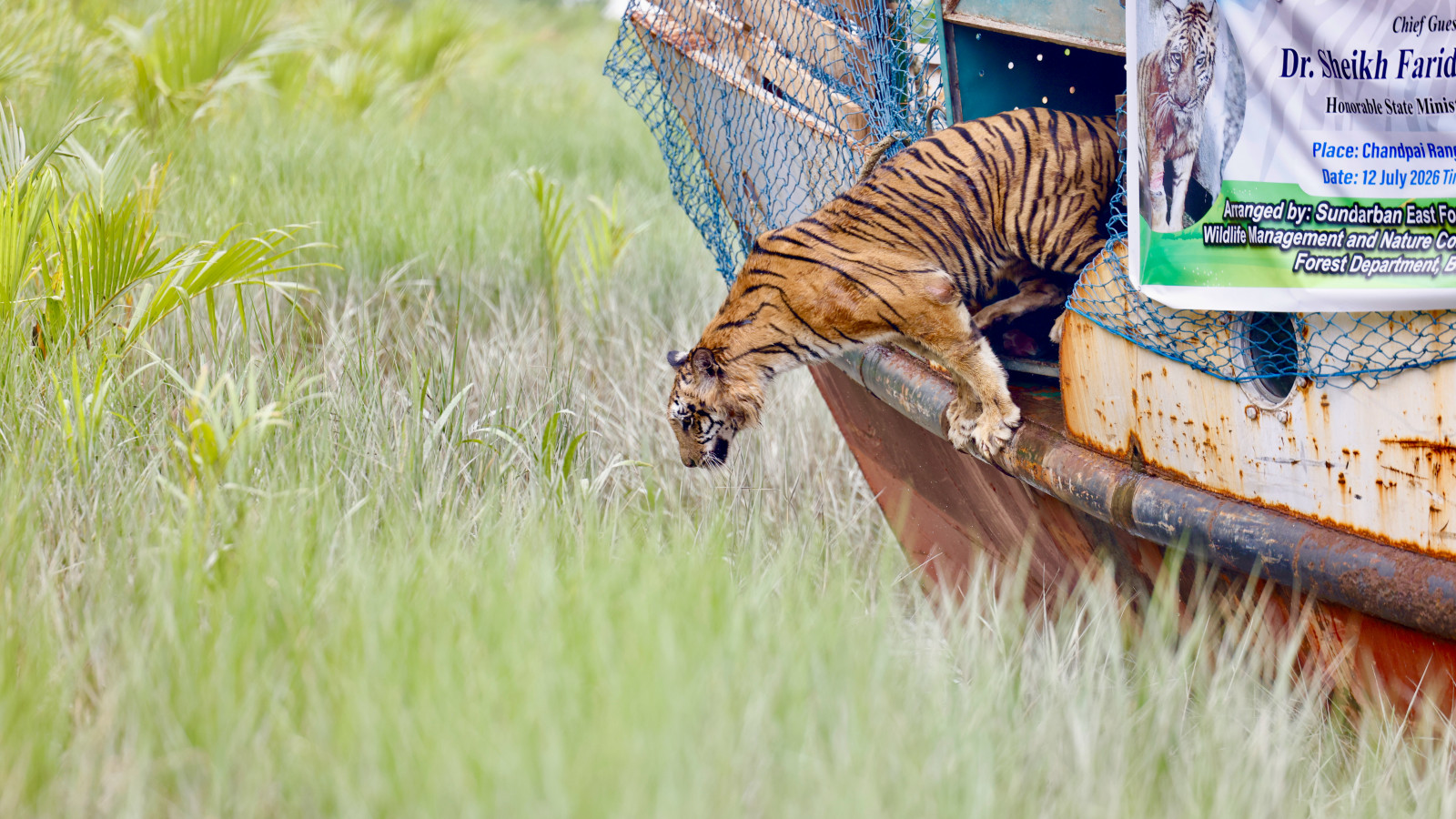
As the sliding door of the 10-foot by 6-foot green box was lifted, nothing happened for some baited moments. A hush fell among the crowd that had gathered on the bank of the Shela River in Andharmanik. Everyone was ready with their mobile cameras to capture that epic moment.
Then the big, bright head of the tigress appeared. Its ears cocked backwards in stress. It looked straight at the crowd with a tired look. That was expected as she was immobilised last night and regained consciousness only a few hours ago.
Then she turned around, its tail hanging from the green steel box as she refused to step out.
 Keep updated, follow The Business Standard's Google news channel
After an hour's effort with a lot of banging on the box, she finally got up and peeked outside at the green mangrove -- her abode for their 11 years of life.
In slow motion, she finally jumped to her freedom, to her home, to the lore of the great Sundarbans that would probably shelter her, feed her and pose great threats as well.
Very slowly, she walked away into the forest this noon (12 July).
The entangled tigress
A narrow canal runs by a village named Sharkir Khal that was once connected with the Baleswar river; engine boats would ply it to distant places. But over time siltation had left the canal unusable. Then the government took a project to excavate it to make it usable once again. Huge excavators came and started digging the canal bed deep.
It was here that some village boys had gathered to watch the work in progress. In this quiet settlement ringed by deep forests and brackish water fish farms, where life still runs on sunrise, and the only entertainment in life is to watch fishnets being hauled at dusk, these behemoths of excavators are quite a stir in the daily rut.
Some of the boys had crossed the canal and strayed about a hundred yards into the forest near a tall tree that could be seen from the village when they heard the unmistakable sound – the angry growl of a tiger furious at being chained.
The baffled boys probed a little deeper, and there it was – behind a dry bush, the bright and jagged yellow and black stripes of a tiger's coat flashed. Its front leg tangled in a deer trap made with synthetic ropes.
Seeing the boys, the tigress gave an almost pleading look. At least the pictures taken of it showed the desperation in its languid eyes. It almost froze for some moments and then flashed its teeth again.
"The boys ran back, screaming 'tiger, tiger'," recalls Alima Begum, a villager. A chill of terror ran down her spine as memories of earlier deaths of village people in tiger attacks flashed through her mind.
The news spread faster than a forest fire, and Mostafa Mridha, who works as a member of the Village Tiger Response Team with a non-profit organisation WildTeam, also heard it while seeping tea in a small marketplace. He immediately informed the officials of the local forest department; a probe party was launched.
Yes, it indeed was a tiger badly entangled in a deer trap. It was already bleeding from its front leg and looked tired from hours of enraged effort to get itself free.
"But we could hardly do anything at that moment," said Mostafa. "It was already getting dark and we cannot approach an angry and cornered tiger. So we set up a patrol team for the night, guarding the animal so that nobody can harm it."
News was sent to the Bagerhat and Dhaka offices of the forest department, and the next day, more officials arrived who immobilised the tiger.
But it proved to be a major daunting task than was thought. Thousands of curious villagers gathered who posed a real challenge to transport the tigress. Video clips of the rescue show the villagers thronging the tigress as it is being lifted into a green box. They would not let the pickup carrying the box go as all of them wanted to take a look at the tigress. The forest officials were almost about to be attacked by the crowd.
But finally it was successfully rescued.
"The successful rescue of the injured tigress by the forest department deserves sincere appreciation," says Dr Reza Khan. "Saving a mature Bengal tiger from almost certain death in one of the world's most challenging ecosystems was no ordinary achievement. It reflected the courage, dedication and professionalism of forest officials."
The traps
The tigress that was found trapped and wounded in the nets of illegal deer hunters six months ago was finally returned to its habitat. A successful first operation in tiger conservation by the Forest Department.
But the rescue and return of the tigress does not signify an end in itself. It also tells of the immense threats that the tigers of the Sundarbans, the last habitat of the Bengal tigers in Bangladesh, face today. Illegal poachers have intruded the forest, laying deer traps made of strong synthetic ropes.
Rezaul Karim Chowdhury, DFO of Sundarbans East Division, is one person who has waged an uphill task of catching the poachers. He and his team of foresters launch daily patrols into the forest on foot, scanning the forest floor inch by inch in search of deer traps.
"It's a frightful situation," Rezaul says.
"Every day, we discover trap after trap. We destroy them and sometimes even arrest the poachers if we chance upon them. But the next day more traps are lain. This is an almost impossible task with such a small team."
Rezaul has a very small team to patrol the forest day in and day out, no matter whether it is a holiday or Eid vacation. And yet he has to chase the poachers in a huge forest that is extremely challenging to guard because of its swampy nature, the sharp breathing roots of the mangrove forest and the knee- to waist- deep mud.
Actually, deer poaching has become so pervasive that you can have any number of deer to be served on your dinner table.
"This unstoppable illegal trade is now the biggest threat to tiger conservation in the Sundarbans," said… "as the deer population diminishes, tigers are left with less and less food. Desperate and hungry, the tigers enter villages or hunt domestic cattle, leading to tiger-human conflict."
Such conflicts peaked in the Chandpai range from around 2006 to 2012. Every night a tiger would enter one village or another.
"A tiger would enter this Joymoni village every night," said Md Alam Hawladar, a field facilitator of WildTeam.
We were sitting in the same village last night and Hawladar showed us the path the tiger would follow through the village. The path was 200 yards from where we stayed.
"We would blast crackers and use hand-held mikes to make noise," Hawladar said. "The tiger would immediately leave the village but would come back the next night."
However, tiger-human conflict has actually decreased over the years with the last tiger being killed in 2018. This is because the villages are now lighted up with access to electricity and tigers are scared of lights.
But deer poaching has certainly put a pressure on food. As prey wanes, tigers would reproduce less or fewer cubs would survive.
The debate
After the tigress was rescued, everybody was thinking what to do with her once she was healed. There are two options – either to send it to the safari park and let it spend the rest of its life in captivity, or to release it into the forest.
The forest department arranged an online meeting with tiger experts of the country to discuss the fate of cat.
Almost everybody was in favour of releasing it into the forest.
"We felt that the tigress is already about 11 years old and only a few years of its life are left," said Md Anwarul Islam, CEO of WildTeam. "Sundarbans is the home of this tigress and it must have a yearning to return to its own place. If we could put a radio collar on the tiger, we could monitor it, and the forest department would gain invaluable experience in tiger conservation. Also, we could monitor whether the cat is entering any village. The collaring was necessary because we could know whether the tigress survived or died. Both information could contribute new chapters to conservation efforts."

There are concerns that since the tigress has been in captivity for six months, its territory has already been occupied by some other individual. So a clear case of territorial conflict presents itself.
But there is also counter argument that when a new animal arrives others will make space for it. And tigers breed and the cubs grow up to occupy new territory. So in the same process, this tigress will also find its own space.
"Moreover, it is a female tiger. So chances are that it will be more easily accepted in the forest with less chance of conflict with male members of the species," said Monirul H Khan, a zoologist at Jahangirnagar University. "The tigress has fully healed, and we hope it is able to hunt again. Its instinct to hunt will remain with it and be restored as it enters the forest."
So in the end, it was decided not to collar the tiger. The decision was probably influenced by the experimentation by a British zoologist, Adam Burlow, who collared two tigers in 2004 and 2006. Both tigers were later found dead, and a debate raged about whether the collaring led to the deaths.
It was suggested by some that the collars were very heavy and either affected the hunting ability of the tigers or led to infection after the collars gathered moss and other things.
So, a decision was made to set up 20 camera traps in the forest to monitor the movement of the tiger to the best of the ability.
So, in the end, the tigress was sent off into the forest today. Every heart present to witness her release silently prayed for its survival.
With all the luck, it may survive another three to four years and may add litters to the forests of 125 tigers at last count in 2024.


