National Bank wants to lease HQ tower to boost income
Cenbank writes govt requesting special facilities

Highlights:
- National Bank seeks approval to lease headquarters Tower-2 commercially
- Bank aims to create income amid severe financial difficulties
- Current banking law prohibits rental income from headquarters properties
- Central bank recommended legal exemption supporting restructuring and stability efforts
- Construction progresses slowly; Tower-2 completed structurally but unfinished
- National Bank faces huge bad loans, deficits, and governance failures
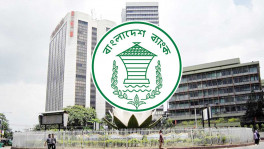
First-generation private lender National Bank has formally sought government approval to commercially lease one of the two towers of its under-construction headquarters in Dhaka's Panthapath, aiming to generate a new source of income as it struggles with mounting financial stress.
The bank has written to the Bangladesh Bank, seeking permission to lease Tower-2 of its proposed "NBL Twin Tower" complex in June, arguing that using both towers solely for its own operations would not be financially viable after completion, officials familiar with the matter said.
 Keep updated, follow The Business Standard's Google news channel

A National Bank director confirmed the development to The Business Standard.
Under the Bank Company Act, banks may own properties necessary for their operations but are not allowed to earn income by commercially leasing office buildings constructed for their own use.
Considering the bank's weak financial condition, on June 29 Bangladesh Bank recommended that the government exempt the lender from the relevant provision of the law, according to a senior finance ministry official.
In its recommendation, the central bank said the headquarters project was originally approved on the condition that it would be used exclusively for the bank's operations. However, as the lender is now undergoing financial restructuring, its board has proposed leasing Tower-2 to create a sustainable source of non-funded income, improve returns on fixed assets and strengthen its balance sheet.
The central bank also noted that allowing the proposal could support the bank's ongoing reform efforts, including board restructuring, liquidity support and measures to restore financial stability and depositor confidence.
National Bank has also exceeded the legal ceiling on fixed assets. Under the Bank Company Act, a bank's investment in fixed assets cannot exceed 30% of its capital base.
Construction progressing slowly
Rajdhani Unnayan Kartripakkha approved the twin-tower project in December 2013 on a 64-katha plot in Panthapath. The complex consists of two 12-storey towers with three basement floors. South Korea's Heerim designed the project, while Donga and local firm MS Construction were appointed to build it.
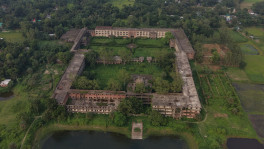
A visit by TBS Reporter found that construction of Tower-1, intended to serve as the bank's headquarters, is progressing slowly because funds are being released in phases.
Tower-2 has already been structurally completed, but finishing work has remained suspended.
Experts oppose legal exemption
A senior Bangladesh Bank official said the existing law does not permit banks to generate rental income from office buildings constructed for their own use.
"The Bank Company Act clearly defines the scope of banking business. Commercially leasing a headquarters building is not allowed under the current legal framework," the official said.
Dr Toufic Ahmad Choudhury, former director general of the Bangladesh Institute of Bank Management, said granting such an exemption would be inappropriate.
"The bank has suffered serious governance failures and its financial condition has deteriorated significantly. The law does not envisage banks earning income through commercial property leasing, and approving such a request would set an undesirable precedent," he said.
Financial condition deteriorates
National Bank remains one of the country's weakest banks.
According to the central bank data as of March, 56.44% of its total loans, worth around Tk24,000 crore, were classified as non-performing, with most categorised as bad loans.
The bank is also facing a provision shortfall of nearly Tk20,000 crore.
As of December 2025, its capital deficit exceeded Tk9,000 crore, while its capital to risk-weighted assets ratio stood at negative 6.11%, well below the regulatory minimum of 12.5%.
A senior official of the bank attributed the crisis to years of poor governance and large-scale loan irregularities.
According to the official, influential business groups, including those linked to the Sikder Group, borrowed heavily from the bank over the years, but much of the money was never recovered. The resulting surge in default loans gradually created severe provisioning and capital shortages, pushing the bank into its current financial distress.