Football, politics and defiance in Jafar Panahi's 'Offside'
In Offside, football is a metaphor for exclusion, a vehicle for protest and, ultimately, a route to freedom.

"You look like a total girl," one football fan says to his fellow passenger.
On a bus rattling towards a packed stadium, the insult barely registers. The air is thick with testosterone, chants bounce off the windows, air horns shriek without mercy, and faces are smeared with team colours.
But there's a delicious irony here: she is a girl. And this is Iran, where women are not supposed to be heading to football matches at all.
 Keep updated, follow The Business Standard's Google news channel
So she lowers her gaze, adjusts her disguise, and hopes nobody looks too closely.
That is the irresistible premise of Offside (2006), writer-director Jafar Panahi's sly, funny and quietly devastating film about women who dare to cross an invisible line.
In football, a player is said to be offside when they step into a position the rules do not permit, caught ahead of play in the opposition's half, and therefore penalised. In Panahi's film, a group of young women find themselves in exactly such a position.

Only here, the offence is not tactical but political. These women are "offside" simply because they are in a football stadium, a place deemed off-limits to them in post-revolutionary Iran.
Place - on the pitch and in public life - is Panahi's central concern.
With a boldness that feels almost mischievous, Panahi shot the film during an actual match at a real stadium, letting real-time events shape its course, with outcomes loosely left open depending on how the game and the crowd unfolded.
Panahi's real subject, however, extends well beyond football. He is interested in something more fundamental: who gets to occupy public space, who gets pushed to the margins, and who writes the rules determining where people belong.
And because Offside is a film about access, exclusion and visibility, it unfolds almost entirely in shared public spaces — buses, roads, stadium entrances, holding areas — places where women are monitored, restricted, and, if necessary, removed.
The film begins with movement.
Amid the wail of sirens and the hum of Tehran traffic, an anxious father searches for his daughter, who has skipped school to watch a crucial World Cup qualifier. He boards a crowded minibus full of fans, hoping to bring her home.
Elsewhere, another bus carries a young woman travelling in silence, trying desperately not to attract attention. Around her, men sing, joke and celebrate. She keeps her head down.
The film ends on another bus journey, but the mood has shifted. Several women who attempted to enter the stadium are being transported to vice squad headquarters, uncertain whether they will be fined, reprimanded or worse.
These two journeys frame a day of rebellion.
After the 1979 Islamic Revolution, women were barred from attending men's football matches in Iran, ostensibly to preserve modesty and maintain gender segregation.
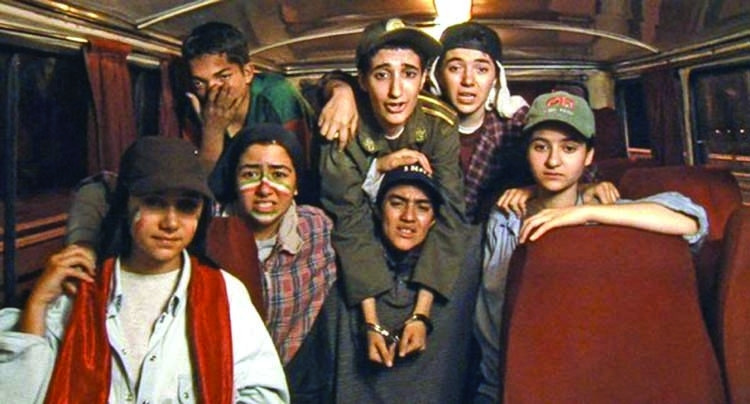
Panahi's heroines respond to this restriction with remarkable creativity. They dress as boys, impersonate officials, paint their faces in national colours, wrap themselves in Iranian flags and, in one memorable case, disguise themselves as football star Ali Karimi.
They even abandon the veil temporarily, gambling that invisibility might come through performance.
Some make it inside. Others are caught.
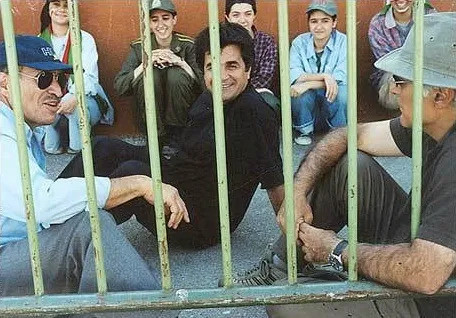
Those detained are placed in a makeshift holding pen just outside the stadium. They can hear the roars of the crowd but cannot see the match itself. The cruelty of the ban lies precisely here: close enough to feel the excitement, yet shut out from participating in it.
The enclosure becomes a miniature version of the larger system — a physical manifestation of exclusion.
But systems, as it turns out, are not very good at suppressing solidarity.
As more women arrive, the holding pen transforms into something unexpected: a community.
Every newcomer is greeted like a goal scorer. Friendships form instantly. The women debate tactics, discuss players, comfort one another and celebrate every snippet of match news.
One attends in memory of a friend killed during a previous football-related commotion. Another, a footballer herself, offers rare insight into women's sport in Iran. Her urgent need for a toilet creates one of the film's funniest sequences — proof that even under oppressive circumstances, biology remains gloriously indifferent to politics.
Then there is the smoker, who asks the question nobody can answer: if women can sit beside men in dark cinemas, why not football stadiums?
It is a wonderfully simple challenge to an absurd rule.
Another woman manages to watch part of the match by disguising herself as a soldier. Yet another reaches for a chador when she spots an older acquaintance, reminding us that frustration with restrictive laws transcends social and ideological divisions.
These are not casual fans dragged along by brothers or boyfriends. They know the players, understand the tactics and care deeply about the outcome. Their determination to infiltrate the stadium is an act of resistance against rules they regard as arbitrary and unjust.
In Offside, football becomes more than a game. It is both the reason for protest and the language through which protest is expressed.
Denied a direct view of the match, the women experience it second-hand. They rely on crowd reactions, radio commentary, a sympathetic soldier's updates and fleeting reports from those who briefly glimpse the action.
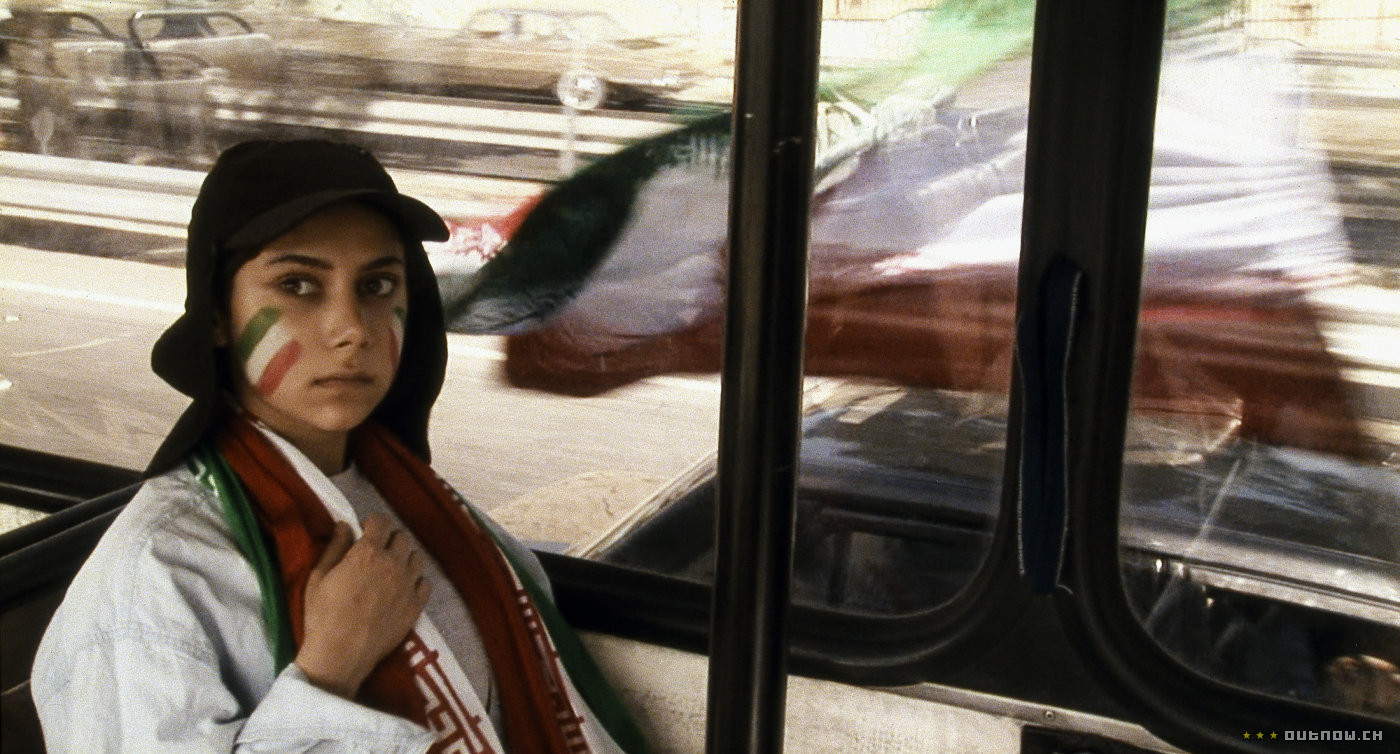
It is fandom reduced to its purest form: passion without access.
The film's most delightful sequence arrives when one of the women, having managed to watch a few minutes of play, recreates the match inside the holding pen. She assigns positions, divides the space into Iranian and Bahraini halves and turns her fellow detainees into stand-ins for the players.
Even the soldiers are recruited.
For a brief moment, roles reverse. The women become the experts; the soldiers become the audience.
Knowledge shifts power.
It is also impossible not to notice that we, the viewers, share the women's perspective. We rarely see the match ourselves. Instead, we watch people watching football. We listen to reactions, imagine the action and piece together events from fragments.
By aligning us with the women's experience, Panahi broadens the film's reach. This is not just a story about six football fans. It is about everyone excluded from public life.
What makes Offside even more remarkable is how it blurs the line between fiction and reality.
The match at its centre really happened. In 2005, Iran defeated Bahrain at Tehran's Azadi Stadium to qualify for the World Cup. Panahi filmed during the actual game, allowing the crowd's energy and the unpredictability of live sport to shape the film in real time.
The women protesting outside the stadium in white scarves were real campaigners advocating an end to the ban.
The inspiration for the story was personal, too: Panahi's own daughter had once been denied entry to a football match.
Yet deception remained necessary.
To secure official approval, Panahi submitted a fake script about boys attending a football game. He listed his assistant director as the film's director and switched to digital video because the smaller cameras attracted less attention.
It was excellent preparation for what came next.
In 2010, Panahi was convicted on charges of propaganda against the Iranian government and handed a 20-year ban on filmmaking, travelling and giving interviews. Since then, he has continued making films clandestinely, smuggling them out of the country for international release.

Restrictions, it seems, only sharpened his creativity.
That spirit of subversion pulses through Offside.
Despite its serious subject matter, the film never feels burdened by its politics. Panahi understands that humour can be disarming and that empathy often achieves what outrage cannot.
The young conscripts guarding the women are not monsters. They are awkward, conflicted and only marginally more powerful than their detainees. They believe they are doing their duty, yet gradually recognise the absurdity of the situation.
Their warmth complicates easy assumptions about Iranian men and shifts blame towards the system itself.
The film reserves its harshest judgment not for individuals but for institutions.
Watching Offside today, however, is an altogether different experience.
In September 2022, Mahsa Amini died in police custody after being arrested for allegedly violating Iran's hijab regulations. Her death sparked nationwide protests under the slogan "Women, Life, Freedom", with women publicly removing headscarves and cutting their hair in defiance.
The demonstrations reached the 2022 FIFA World Cup in Qatar, where Iranian fans carried placards and players declined to sing the national anthem.
Suddenly, Panahi's fictional rebels no longer feel symbolic. They feel prophetic.
And yet the film's ending remains stubbornly optimistic.
As Iran secures qualification for the World Cup, joy erupts across Tehran. Fear evaporates. Soldiers loosen their grip. The women escape into the celebrations.
For a few glorious minutes, football dissolves barriers that politics has spent decades erecting.
Seen through the lens of recent events, the conclusion may appear naïve. But perhaps that is precisely Panahi's point.
Football asks us to believe in improbable things every week. Last-minute winners. Underdogs triumphing. Bitter rivals embracing after the final whistle.
Why should social change be any less miraculous?
In Offside, football is a metaphor for exclusion, a vehicle for protest and, ultimately, a route to freedom.
Offside turns football into camouflage.
Only a football match, Panahi suggests, could make such an ending feel possible.