China firm now to develop economic zone on delisted Mongla site for India
The site was earlier designated for India but delisted in 2025.

Bangladesh has signed an agreement with a Chinese state-owned company to develop an economic zone at Mongla on land originally earmarked for an Indian economic zone, marking a significant shift in the country's investment strategy as it seeks to attract greater Chinese investment.

The Bangladesh Economic Zones Authority (Beza) signed a memorandum of understanding with China Civil Engineering Construction Corporation yesterday (25 June) in Beijing for the China-Bangladesh Mongla Port Economic Zone, which will be developed on 110 acres of land adjacent to Mongla Port in Bagerhat.
Prime Minister Tarique Rahman, who is now in China on a state visit, was present during the signing of the MoU.
The site had previously been allocated for an Indian economic zone under a bilateral initiative launched in 2015. However, the interim government delisted the project in October 2025 after the Indian government-nominated developer failed to begin work within the stipulated timeframe.
 Keep updated, follow The Business Standard's Google news channel
Investment drive gains momentum
The Mongla agreement was among several investment-related deals signed during Tarique's visit aimed at strengthening economic cooperation with China.
Beza also signed and exchanged a developer agreement with China Road and Bridge Corporation for the Chinese Economic and Industrial Zone in Anwara, Chattogram.
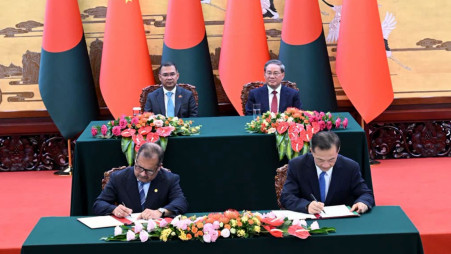
In addition, the Bangladesh Investment Development Authority (Bida) signed a memorandum of understanding with the China Council for the Promotion of International Trade to promote investment, strengthen business linkages and provide support services for Chinese investors in Bangladesh.
Separately, China's Handa Group was allocated land in the Keraniganj Economic Zone. According to a Bida press release, the company plans to invest $220 million in the project.
Shift from Indian-backed project
Bangladesh and India signed a memorandum of understanding in 2015 to establish two Indian economic zones, one in Mongla and another in Mirsarai, Chattogram. The projects were intended to be implemented under India's Line of Credit programme.
As part of plans to encourage investment in the Mongla Economic Zone and strengthen bilateral trade through Mongla Port, the two countries constructed a new railway line between Mongla Port and Khulna under Indian financing.
The Indian government nominated the Hiranandani Group as the developer for the Mongla project's land development component on 21 March 2018. Subsequently, Beza signed a memorandum of understanding with the group's subsidiary, Evita Constructions Private Limited, on 2 March 2022.
Following the political transition in Bangladesh in August 2024, the project remained unimplemented. According to Beza officials, the Indian developer failed to commence land development work within the two years stipulated in the agreement.
Beza officials said the Chinese Embassy in Dhaka proposed establishing a Chinese economic zone on the same site in June 2025. The Office of the Chief Adviser later formally delisted the Indian-backed project.
Development plans
Beza Executive Member Major General (retd) Md Nazrul Islam said Chinese investors had expressed interest in establishing high-value-added manufacturing industries in the Mongla Economic Zone.
"Chinese investors have shown interest in setting up high-value-added industries in the Mongla Economic Zone. They have indicated plans to establish manufacturing facilities in sectors including telecommunications and electronics. There is also interest in developing warehousing facilities," he told The Business Standard.
Nazrul said the newly signed agreement represents only a government-to-government understanding at this stage.
"Following the signing of the MoU, the Chinese side will prepare a detailed master plan. We will then review the proposal through our technical and negotiation committees before proceeding with subsequent agreements," he said.
Nazrul added that Beza does not intend to make significant new financial commitments to the project.
"We will provide the land, while the developer will undertake infrastructure development and other investments. Whether Beza will receive an equity stake in exchange for the value of the land will be determined through future negotiations," he said.