Business leaders decry Customs 'harassment'
Realtors seek ‘no-questions-asked’ facility to whiten black money at lower tax rates

Business leaders have complained of widespread harassment and arbitrary taxation by customs officials, particularly at Chattogram Custom House, urging National Board of Revenue Chairman Abdur Rahman Khan to intervene and provide redress.
The complaints were raised by several business representatives during a pre-budget discussion with the chairman organised by the NBR today.
At the discussion, Ali Newaz Khan, CEO of Beximco Pharmaceuticals Ltd, said, "We [businesses] are exhausted by the troubles at Customs. We are not getting any resolution."
 Keep updated, follow The Business Standard's Google news channel
"They [customs officials] determine HS codes, assessment and valuation in whatever way they wish," he added, referring to the classification system used to determine import duties.
"If you look into this matter, it will reduce our hassles somewhat," Ali Newaz noted.
At the same event, Mohammad Zakir Hossain, former general secretary of the Bangladesh Association of Pharmaceutical Industries (BAPI), recounted his own experience of harassment at the Chattogram Custom House.
"Despite having approval from the Directorate General of Drug Administration (DGDA), I was charged Tk1.80 crore in import tax on raw materials instead of Tk42 lakh … I also had to pay Tk19.50 lakh in port demurrage," he said.
He explained that the same product had been imported seven times earlier under the previous tax category. "But this time the HS code was changed and it was assessed as a food supplement, forcing me to pay higher tax," he added. "But we use this raw material to manufacture medicine."
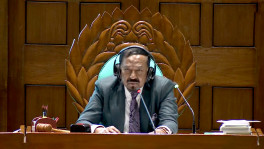
Responding to the concerns, NBR chairman Abdur Rahman Khan acknowledged that complaints about Customs were frequent. "We receive complaints about Customs, and there has been a lot of discussion about this."
"Why are you [customs officials] not accepting the DGDA certificate? This is a serious issue." he noted.
He added that the matter would be reviewed from a legal standpoint. "We will check and examine the legal aspects. If any change is required, it will be made."
The chairman also said a joint committee involving both the authorities and business representatives could be formed to address existing problems. The committee would meet every three months to work on solutions.
Leaders of the Bangladesh Foodstuff Importers Association also raised concerns during the discussion, saying high tariffs on imported food items – particularly baby food – were driving up prices.
They said some products were more expensive in Bangladesh than in Europe. Because of rising prices, legal imports of baby food were declining, they added, while more products were entering the country through "other routes".
Realtors seek 'no-questions-asked' facility
During the same discussion, the Real Estate and Housing Association of Bangladesh (REHAB) called for the reinstatement of a policy allowing investment of undisclosed income (black money) in the housing sector at lower tax rates without questioning the source of funds.
Md Wahiduzzaman, president of REHAB, and Liakat Ali Bhuiyan, the association's senior vice-president, highlighted the current challenges facing the sector.
The organisation said the previous provision in the income tax ordinance should be reinstated so that authorities cannot question the source of funds used to purchase flats.
Liakat said, "Many expatriates send money but do not make a declaration afterwards. That money then becomes undeclared or black money."
"If they are not allowed to buy flats with this money, the funds are moving abroad," he added.
REHAB also proposed reducing existing registration costs for buying and selling flats and providing incentives to develop a secondary market in the housing sector.
NBR rejects proposal
Responding to the proposal, the NBR chairman said the government was moving away from such policies. "We have been in this culture for 55 years. We will not continue with it."
He noted that sending money through formal channels had become easier and the government was offering incentives for remittances.
"So expatriates should whiten their money by paying tax at the regular rate. It cannot be done in any other way," he added.
The government had introduced a special provision in the 2020-21 fiscal year, allowing investment of undisclosed money in the housing sector without any questions from authorities. Moreover, while ordinary buyers had to pay taxes at rates of up to 30%, the tax on such investments was set at just 10%.
Later, in the proposed Bangladesh national budget for the 2024-25 fiscal year, the government increased the tax rate for whitening black money from 10% to 15%.
However, the provision to whiten black money drew widespread criticism across the country since its introduction.
In September 2024, the provision was eventually cancelled by the NBR at the decision of the then-interim government.
At present, there is no reduced tax rate for investing undisclosed income in the housing sector. Investors must pay the regular tax rate along with penalties.
Authorities such as the Anti-Corruption Commission or other government agencies can also question the source of funds.