Why dollar rate is rising again
Several commercial banks purchased remittance dollars from exchange houses yesterday at Tk123.75 per dollar, about 10 paisa higher than in early July.
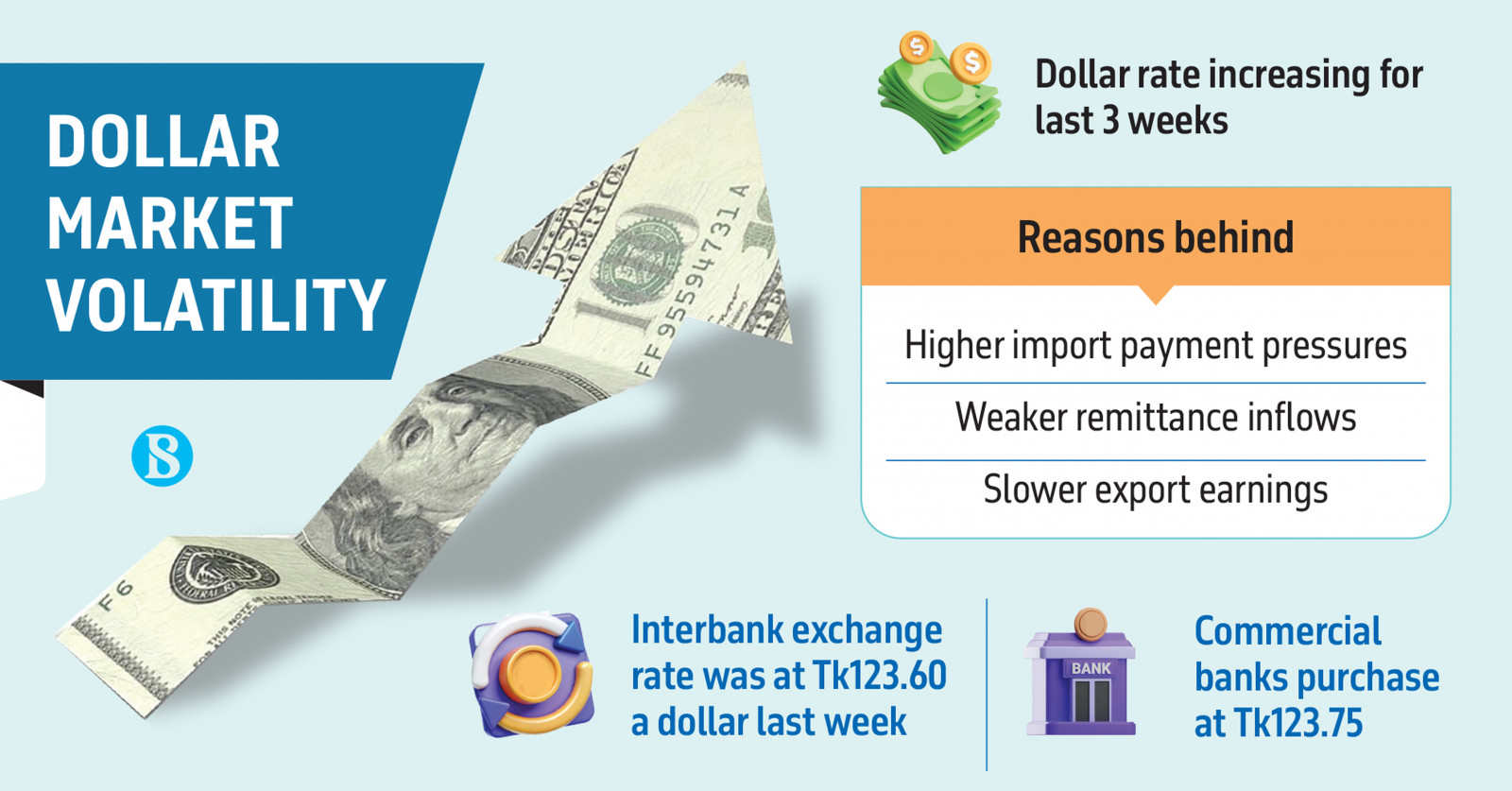
The US dollar has resumed its upward trend over the past three to four weeks, driven by higher import payment pressures, weaker remittance inflows, slower export earnings and changing market expectations following recent discussions between the Bangladesh Bank and the International Monetary Fund, according to bankers and central bank officials.
Yesterday (20 July), several commercial banks purchased remittance dollars from exchange houses at Tk123.75 per dollar, about 10 paisa higher than in early July. Bangladesh Bank data also show the interbank exchange rate rose by 75 paisa over the past week to Tk123.60.
Although the central bank had kept the benchmark interbank rate at Tk122.85 for a prolonged period, treasury officials say actual transactions were rarely conducted at that level.
Bangladesh Bank data show that letters of credit worth more than $7 billion were settled in June, with government imports accounting for a significant share. Higher global prices of fuel and fertiliser, partly due to the conflict in the Middle East, pushed up import costs and increased demand for foreign currency.
 Keep updated, follow The Business Standard's Google news channel
Since LCs are generally settled one to three months after opening, many import orders placed in March and April became due in June and July.
In addition, a large number of deferred-payment UPAS [Usance Payable at Sight] LCs opened during Ramadan were settled in June, while some are still being settled this month, keeping demand for dollars elevated.
Meanwhile, foreign currency inflows have weakened. Bangladesh received $2.82 billion in remittances in June, the lowest monthly inflow in eight months.
Export earnings have also declined. According to the Export Promotion Bureau, merchandise exports fell by $4.2 billion in FY26 compared with the previous fiscal year, reducing the supply of dollars in the banking system.
Bangladesh Bank's Economic Indicators report shows LC settlements reached $70.4 billion in FY26, slightly higher than $70.3 billion a year earlier, indicating import demand remained strong despite slower export growth.
Bankers also attribute the market's volatility to aggressive competition among some commercial banks for remittance dollars. Treasury officials say some banks are paying higher prices to secure remittance inflows while selling dollars at lower rates, particularly for government LC payments, creating distortions in the foreign exchange market.
Market expectations have also shifted following recent IMF discussions. Officials said the IMF questioned why Bangladesh Bank's dollar purchases through auctions remained within a narrow price range.
After the meetings, the central bank began publishing the prevailing interbank exchange rate on its website instead of the earlier benchmark, reinforcing expectations that the exchange rate would be increasingly market-driven.
A senior Bangladesh Bank official said that, as the government negotiates a new IMF loan programme, the central bank is refraining from informal intervention in exchange rate determination, encouraging exchange houses to seek higher prices for remittance dollars.